
Vogelbusch Bioethanol Technology
Bioethanol is dehydrated (highly concentrated) ethanol used as additive to transport fuel. It is a readily available, clean fuel for combustion engines that blends easily with gasoline.
Made from organic matter with advanced, energy saving production technology, bioethanol can considerably reduce traffic related greenhouse gas emissions. Low carbon emissions are a main objective of biofuel promotion policies.
We design facilities that can process ethanol from a wide range of starch or sugar-containing crops. Feedstocks include wheat, corn, milo, barley, rye, potatoes, cassava, sweet potatoes and wet milling by-products, as well as sweet sorghum, sugar cane and sugar beet in the form of molasses, thick juice or syrups. Last but not least products from cellulose conversion processes ("second generation") are utilized.
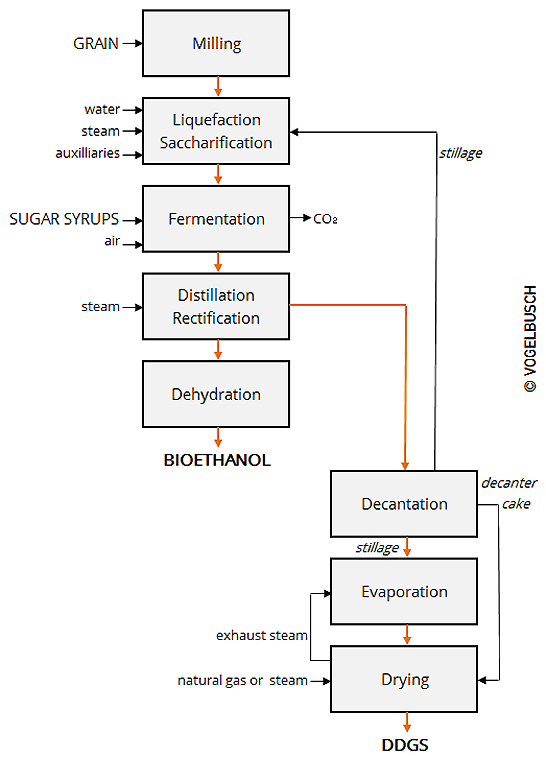
Block diagram
Vogelbusch process for bioethanol production
Yeast is used to ferment sugars into ethanol which is refined and concentrated in further process steps.
Adjusted to feedstock
RAW MATERIAL PREPARATION
STARCH: Grains and tubers are milled before they are used in the process. Starch or by-products from wet milling plants do not require any special treatment and are fed directly to liquefaction.
SUGAR: Molasses and sugar syrups seldom require special treatment; they are diluted and acidified and fed straight to the fermentation unit. For substrates containing large amounts of inhibiting substances (affecting fermentation), pasteurization and/or stripping may be necessary. Occasionally, a sludge removal process may be required.
DESIGN OPTION
DRY MILLING OR WET MILLING
Each option has its advantages
- In the dry milling process the feed contains all the fibers, husks, etc. of the grain. The process is robust and simple, and provides good DDGS as a co-product
- In wet milling plants a clear substrate without fibers or sludge is used for ethanol production. The yield is higher but no DDGS is obtained
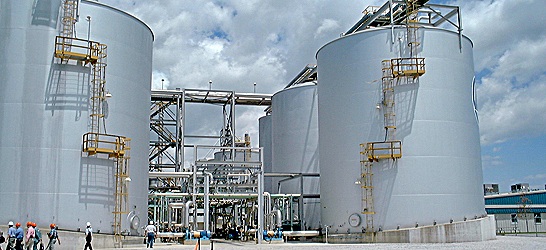
Transformation into alcohol
BIOREACTION
Starch is treated by liquefaction and saccharification to obtain glucose as a fermentable sugar. The part-saccharified substance is cooled down and fed directly to the fermentation unit. Final conversion of the starch into glucose takes place simultaneously during fermentation. To reuse water and latent heat, the Vogelbusch HotMash© process recycles a decanted stillage stream to liquifaction/saccharification.
At the fermentation stage, yeast is employed to convert monosaccharides into alcohol. The Vogelbusch standard fermentation process in bioethanol production is our advanced MultiCont© continuous fermentation.
Fermentation of the substrate starts in a pre-fermenter under adjusted conditions that promote yeast growth. The fermenting mash flows steadily through a series of main fermenters, while the alcohol increases in concentration. Final alcohol concentrations in the mash of
13 – 15 % vol, (depending on raw material) are regularly achieved.
From the last fermenter the alcohol mash is fed to an intermediate tank for distillation.
Conventional batch fermentation systems can be employed for particularly challenging raw materials.
With some non-fibrous substrates such as molasses or starch milk, yeast recycling can be used to improve yield and accelerate fermentation.
The heat generated during fermentation is reused via external heat exchangers, exhaust air from the fermenters is led through a scrubber for recuperation of alcohol and carbon dioxide.
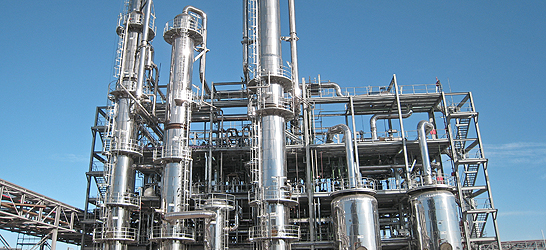
Final product
PRODUCT ISOLATION AND CONCENTRATION
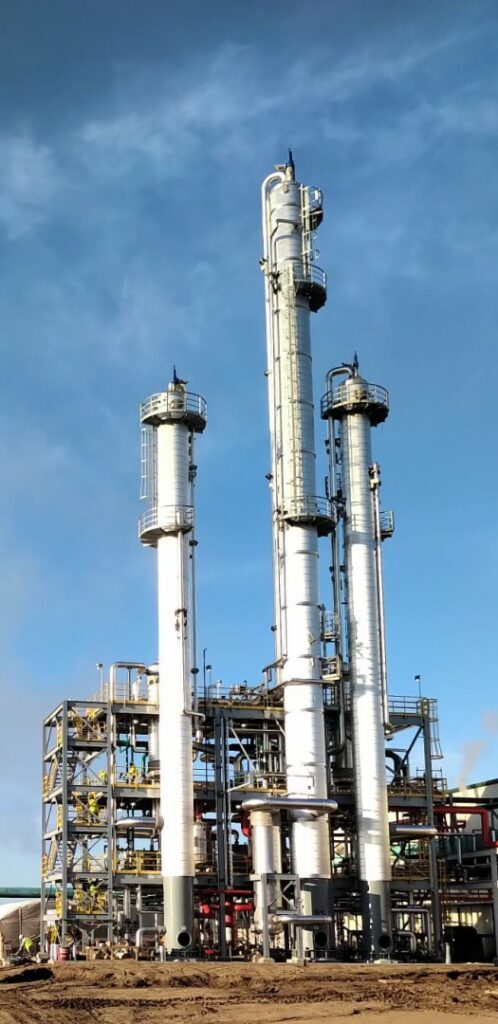
The alcoholic mash is preheated and fed to the distillation column where the crude alcohol is stripped from the mash, leaving behind an alcohol-free liquid, the stillage. The crude alcohol is purified and concentrated to approximately 94 % vol, in several process columns in series.
Vogelbusch’s proven MultiPressure distillation system saves live steam; in conjunction with advanced thermal integration techniques, the energy consumption of distillation, rectification and dehydration unit is as low as 1,150 kg steam per 1,000 liters of bioethanol.
A dehydration process is used to obtain anhydrous ethanol. Standard Vogelbusch dehydration technology employs a pressure swing adsorption (PSA) process using molecular sieves. The final water content can be reduced below 0.05 % wt.
Depending on legal requirements, denaturing of the ethanol may be necessary to make it inedible by the addition of certain substances.
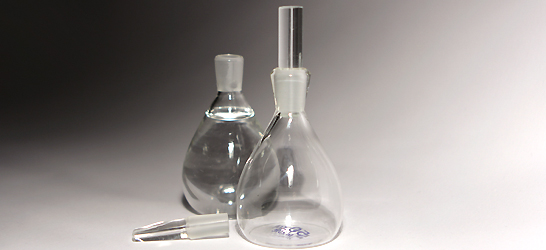
Product standards
We have the technology and experience to design processes for a wide range of applications and product specifications. Vogelbusch column systems are optimized to comply with fuel ethanol standards such as ASTM D4806 (U.S.) or EN 15376 (EU), or individual consumer specifications.
Analytic testing is one of the tasks in our laboratory.
Adding value to production
CO-PRODUCT UTILIZATION
As only the sugar respectively starch is needed for the process, the remaining ingredients of the raw material in turn can provide valuable co-products.
Stillage from beet or cane molasses is directly fed to the evaporation section where it is concentrated in a range of 30 – 65 % DS, depending on the purpose of use. The concentrated molasses stillage (vinasses) can be sold as animal food additive or fertilizer, or incinerated to generate process steam. No concentration is required for biogas production.
Grain stillage contains proteins, minerals, fat and fibers which make a valuable animal feed. Insoluble substances in grain stillage are separated in a decanter and mixed with concentrated stillage from the evaporation section before it is sent to the drying section. The dried product is sold as powdered or pelletized distillers’ dried grains with solubles (DDGS). Alternatively, especially for smaller plants, stillage and the solids from decanter can be sold directly. Stillage is also a potential on-site biomass or biogas power source.
Saving energy and water
Our engineering approach is industry-leading performance in terms of primary energy and freshwater consumption
- Latent heat from stillage recycling, hot condensates and lutter water reduces not only the energy consumption but also the water demand in the raw material preparation
- Pre-concentration of stillage in distillation unit reboilers reduces steam demand in evaporation
- Reuse of drying vapors in the evaporation section and return of residue vapors to the dryer – closed loop principle significantly reduces the atmospheric emissions
- Using condensates and lutter water as replacement for fresh water in process and utilities minimizes water consumption and liquid discharge
Energy efficiency is a proven, cost-effective way of lowering carbon intensity scores and producing ethanol in an environmentally friendly way.
DESIGN OPTION
GAS DRYER OR STEAM DRYER
Decisions on dryer technologies are a matter of energy availability and cost. Where cheap steam is available indirect steam heated tube bundle dryers are used. Otherwise gas or light fuel oil fired dryers are employed. Both ring and rotary drum dryers are suitable.
Reducing impacts on production cost
The most important cost factors in bioethanol production are raw materials, energy and initial capital costs.
Our advanced process design concepts for bioethanol plants have a significant impact on these cost drivers and on plant availability. Key issues in this regard are
Continuous fermentation process
- Low investment and operating costs
- Outstanding yields, concentration and productivity
- Reliable and stable operation for extended periods
- Easy operation thanks to full automation
Low thermal energy consumption
- Recovery and reuse of secondary energy from process streams
- Heat integration at each process stage and across the plant as a whole
Water saving and wastewater avoidance
- Stillage recirculation
- Residue water recirculation and reuse of vapor condensate
- Reuse of treated wastewater in utilities (e. g. cooling towers) or for process needs
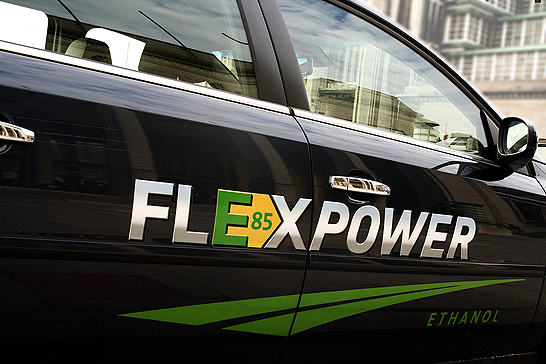
Applications of bioethanol
Bioethanol can be utilized in combustion engines in different ways
Hydrous ethanol (95 % by volume) contains some water. It can be used directly as a gasoline substitute in cars with modified engines.
Anhydrous (or dehydrated) ethanol is free of water and at least 99 % pure. It can be blended with conventional fuel at rates between 5 % (E5) and 85 % (E85). Practically all cars nowadays can utilize E5, most of it even E10; the use of E85 requires socalled FlexFuelVehicles.
ETBE (ethyl-tertiary-butyl-ether) is a gasoline additive that is manufactured from bioethanol.
CUSTOMIZED SOLUTIONS
Continuous development and improvement of our expertise ensures that all our technologies are truly state-of-the-art and not just off-the-shelf designs. Vogelbusch offers flexible design concepts with highly specialized custom solutions that optimize process economics for
- Use of multiple feedstocks
- Combined or alternative production of bioethanol, industrial and neutral alcohol (product switch distilleries)
- Compliance with precise specifications for product quality, steam pressure, etc.
- Local maintenance and construction conditions
Highly skilled experts are also available to upgrade or revamp existing plants to increase capacity, improve yield and/or product quality, and save energy and water. We also assist producers seeking to diversify and gaining revenue from by-products from the ethanol-making process.
Average consumption figures for bioethanol production
All figures given here are typical and can vary depending on plant configuration and equipment.
| Consumption for 1,000 l bioethanol | ||
|---|---|---|
| Wheat | kg | 2,420 |
| Starch content | % | 62 |
| Steam * | kg | 1,400 [3,150] |
| Power | kWh | 115 [260] |
| Cooling water ** | m³ | 95 [175] |
| Process water *** | m³ | 2.7 |
**) Cooling water dt = 10K
***) Process water partly replaceable by treated condensates
Values in square bracket [ ] include DDGS drying.
Additionally minor amounts of chemicals are necessary; consumption depending on raw material quality.
The amount of enzymes required in starch conversion depends on the producer.
| Consumption for 1,000 l bioethanol | ||
|---|---|---|
| Corn | kg | 2,285 |
| Starch content | % | 65 |
| Steam * | kg | 1,250 [2,750] |
| Power | kWh | 110 [220] |
| Cooling water ** | m³ | 90 [165] |
| Process water *** | m³ | 2 |
**) Cooling water dt = 10K
***) Process water partly replaceable by treated condensates
Values in square bracket [ ] include DDGS drying.
Additionally minor amounts of chemicals are necessary; consumption depending on raw material quality.
The amount of enzymes required in starch conversion depends on the producer.
| Consumption for 1,000 l bioethanol | ||
|---|---|---|
| Cassava chips | kg | 2,320 |
| Starch content | % | 65 |
| Steam | kg | 1,350 |
| Power | kWh | 115 |
| Cooling water * | m³ | 90 |
| Process water ** | m³ | 4 |
**) Process water partly replaceable by treated condensates
Additionally minor amounts of chemicals are necessary; consumption depending on raw material quality.
The amount of enzymes required in starch conversion depends on the producer.
| Consumption for 1,000 l bioethanol | ||
|---|---|---|
| Molasses | kg | 3,210 |
| Sugar content * | % | 50 |
| Steam | kg | 1,700 [3,000] |
| Power | kWh | 70 [100] |
| Cooling water ** | m³ | 100 [160] |
| Process water *** | m³ | 7 |
**) Cooling water dt = 10K
***) Process water partly replaceable by treated condensates
Values in square bracket [ ] include vinasses concentration.
Additionally minor amounts of chemicals are necessary; consumption depending on raw material quality.
| Consumption for 1,000 l bioethanol | ||
|---|---|---|
| Cane or sweet sorghum juice | kg | 8,640 |
| Sugar content * | % | 18 |
| Steam | kg | 1,200 [2,550] |
| Power | kWh | 60 [90] |
| Cooling water ** | m³ | 100 [170] |
| Process water *** | m³ | 1 |
**) Cooling water dt = 10K
***) Process water partly replaceable by treated condensates
Values in square bracket [ ] include vinasses concentration.
Additionally minor amounts of chemicals are necessary; consumption depending on raw material quality.
FAQ
All information given here is typical and can vary depending on plant configuration. For particular information please send us a message with your project details.
The economic minimum capacity of a bioethanol plant is at 300,000 liters per day (= 100,000 tons per year) in Europe; provided that energy cost are favourable it may be 100,000 liters per day in other regions.
For 1,000 liter alcohol (on average sugar / starch content, all on wet basis) the Vogelbusch bioethanol process requires
- Corn 2,350 kg
- Wheat 2,630 kg
- Sugar Beet 10,000 kg
- Sugar Cane 11,000 kg
Combination of feedstocks is possible, but higher investment costs to cover the different process steps have to be taken into account.
Decisive factors for the plant location are
- Short transport routes for raw material and product
- Availability of energy (preferable biomass = CO2 reduction)
For a 300,000 liters per day facility 5 to 6 hectare are required.
Capital expenditure depends on plant capacity and configuration as well as local conditions. Costs for the process plant (excluding building, auxiliaries, infrastructure) for a 300,000 liters per day facility are in the range of 30 to 50 million euros.
In detail this is however depending on the available infrastructure and the raw material used. Grain based plants require higher investment compared to sugar.
Figures are for general reference only since each project has its own particularities that need consideration.
With permits on hand engineering and construction takes 18 – 24 months.
Complete our bioethanol design questionnaire and send it back to us to get a professional opinion on your project.